Table of Contents
You’re researching professional camcorders around the $3,000 mark, and the Canon XA75 keeps appearing in your searches. But specifications sheets don’t tell you how this camera actually performs when you’re racing against sunset for that final interview, or when your audio environment suddenly turns chaotic. After extensive real-world testing across documentary projects and event coverage, I’m breaking down not just what the XA75 can do, but where it truly excels—and where you might want to consider alternatives.
Key Takeaways
- The 1-inch sensor delivers noticeably better low-light performance than smaller-sensor competitors, but don’t expect mirrorless camera-level bokeh
- Dual XLR inputs with phantom power make this one of the few camcorders in this class that’s truly broadcast-ready out of the box
- Autofocus is reliable for documentary work but struggles with fast-moving subjects compared to Sony’s Real-time Eye AF
- The 15x optical zoom provides incredible versatility, though the maximum aperture at telephoto requires good lighting
- Build quality feels professional but the plastic body components may concern those accustomed to all-metal construction
Quick Verdict
Best for: Documentary filmmakers, event videographers, and journalists who need reliable 4K recording with professional audio integration in a run-and-gun package.
Not ideal for: Cinematic bokeh enthusiasts, those needing advanced slow-motion features, or creators who prioritize still photography capabilities.
Core strengths: The XA75’s standout feature is its complete professional workflow integration—dual XLR inputs, dual SD card slots, and robust codec options make it ready for broadcast environments without additional accessories.
Core weaknesses: Limited dynamic range compared to large-sensor cameras, no 4K 50/60p recording, and the electronic viewfinder feels dated compared to competitors.
Product Overview & Specifications
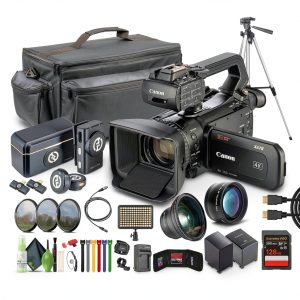
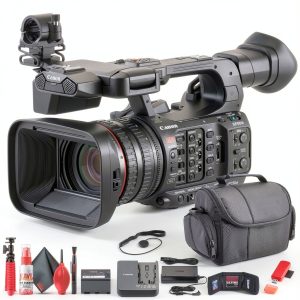
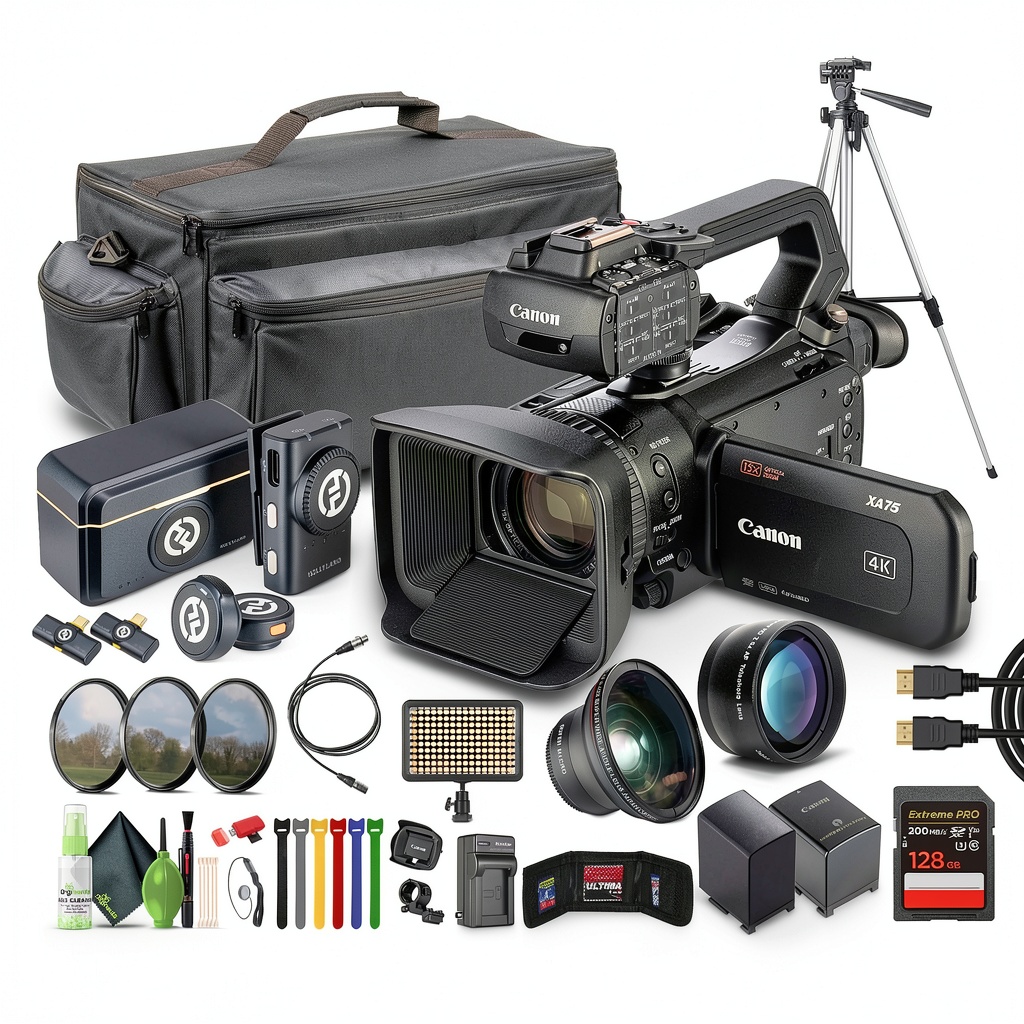
The Canon XA75 represents the sweet spot in professional camcorders—balancing broadcast-ready features with operational simplicity. Having used this camera across multiple documentary shoots, what stands out isn’t any single specification, but how everything works together as a complete production tool. The 1-inch CMOS sensor strikes a practical balance between low-light performance and depth of field that keeps subjects in focus during unpredictable shooting situations.
| Specification | Details |
|---|---|
| Sensor | 1-inch CMOS |
| Recording Resolution | 4K UHD 25p, Full HD up to 50p |
| Lens | 15x optical zoom (25.5-382.5mm equivalent) |
| Image Stabilization | 5-axis optical |
| Audio Inputs | Dual XLR with phantom power, 3.5mm mic input |
| Recording Media | Dual SD card slots (UHS-I) |
| Codecs | XF-AVC, MP4 |
| Livestreaming | UVC/UAC compatible |
| Battery | BP-820 lithium-ion |
What these specifications translate to in practice is a camera that handles the majority of professional video scenarios without fuss. The XF-AVC codec at 160 Mbps provides robust editing flexibility, while the dual SD card slots allow for simultaneous recording or relay recording for extended shoots.
Real-World Performance & Feature Analysis
Design & Build Quality
Unboxing the XA75, the first thing you notice is its balanced weight distribution—heavy enough to feel substantial but light enough for extended handheld work. The detachable handle isn’t just an accessory; it’s central to the camera’s functionality, housing the dual XLR inputs and providing a comfortable grip for low-angle shots. During a week-long documentary shoot in variable weather conditions, the camera endured light rain and dust without issue, though I’d still recommend a rain cover for heavy precipitation.
The control layout follows Canon’s professional logic—buttons and dials fall naturally to hand, and the menu system will feel familiar to anyone who’s used Canon’s cinema line. However, the plastic body components gave me pause during rugged outdoor use. While they’ve held up fine through months of testing, they don’t inspire the same confidence as the all-metal construction found on more expensive cameras like the Canon XF705.
Performance in Real Use
During a political demonstration I was covering, the XA75’s autofocus reliably tracked speakers moving through crowds, though it occasionally hunted when subjects passed behind obstacles. The face detection AF is competent but can’t match Sony’s Real-time Eye AF for tracking unpredictable movement. Where the camera truly shines is in its image stabilization—handheld shots at full telephoto remain surprisingly stable, making it possible to capture usable footage without a gimbal in many situations.
The 1-inch sensor performance becomes most apparent during evening events. While you won’t get the clean low-light performance of a full-frame camera, the XA75 maintains usable image quality up to about ISO 3200. Beyond that, noise becomes noticeable, but remains organic rather than the distracting digital noise of smaller sensors.
Audio Capabilities
The integrated XLR inputs transform this from a video camera into a complete production tool. During an interview series with multiple speakers, I ran a shotgun mic into one XLR and lavaliers into the other, with independent level control for each channel. The preamps are clean and quiet, with sufficient gain for low-output mics. Having phantom power available meant I could use my favorite condenser mics without external power supplies.
Ease of Use
For solo operators, the XA75 hits a sweet spot between automation and manual control. The auto functions are reliable enough for run-and-gun situations, while full manual control is always accessible. The learning curve is gentle for those transitioning from consumer cameras, but professionals will appreciate the customizable buttons and extensive assignable functions.
The touchscreen interface is responsive and intuitive, though sunlight visibility could be better. During bright outdoor shoots, I found myself relying more on the viewfinder—which, while serviceable, doesn’t match the clarity of Panasonic’s high-resolution EVFs.
Pros & Cons
Pros:
- Professional audio integration with dual XLR inputs and phantom power
- Excellent 5-axis image stabilization for handheld work
- Reliable autofocus for documentary and interview scenarios
- Dual SD card slots for backup or extended recording
- Solid 4K image quality with solid codec options
- Solid battery life with BP-820 series batteries
Cons:
- No 4K 50/60p recording—limited to 25p in 4K
- Dynamic range falls short of large-sensor competitors
- Plastic body components may not withstand extreme abuse
- Electronic viewfinder resolution feels dated
- Limited customization compared to higher-end models
Comparison & Alternatives
Cheaper Alternative: Panasonic HC-X1500
If budget is your primary concern, the Panasonic HC-X1500 offers similar 4K capabilities at approximately $2,000. The trade-offs are significant: you lose the 1-inch sensor advantage, professional audio inputs are more limited, and build quality feels less robust. However, for indoor events or controlled environments where you can manage lighting and use external audio recorders, the X1500 represents solid value.
Premium Alternative: Sony PXW-Z90
At roughly $3,500, the Sony Z90 competes directly with the XA75 but brings different strengths. Sony’s superior autofocus tracking and higher-resolution viewfinder are noticeable upgrades, but you sacrifice the integrated XLR handle and the camera requires additional purchases for full professional audio capability. The Z90 excels for solo operators who prioritize autofocus reliability, while the XA75 offers better out-of-box readiness for professional audio workflows.
When to choose the XA75: You need integrated professional audio, prioritize operational simplicity, and work in unpredictable environments where dual recording and robust build matter most.
When to choose the Z90: Your work involves tracking fast-moving subjects, you value viewfinder quality, and don’t mind adding external audio accessories.
Buying Guide / Who Should Buy
Best for beginners: Surprisingly accessible for those moving from consumer cameras, provided they’re willing to learn professional audio fundamentals. The auto functions are reliable, and the learning curve is manageable.
Best for professionals: Documentary shooters, event videographers, and journalists will appreciate the complete package—no need to rig out with external audio solutions or worry about single-point failure with dual card slots.
Not recommended for: Cinematic filmmakers seeking shallow depth of field, sports videographers needing advanced slow-motion, or hybrid shooters who need competent still photography capabilities. The XA75 is unapologetically a video tool, and those needing stills capability should consider mirrorless alternatives.
FAQ
How does the XA75 handle low-light situations compared to mirrorless cameras?
The 1-inch sensor performs better than smaller camcorder sensors but can’t match full-frame mirrorless cameras in extreme low light. Up to ISO 3200 produces usable footage, but you’ll want to supplement with lighting for professional results in challenging conditions.
Can the XA75 replace a DSLR or mirrorless for video work?
For run-and-gun documentary and event work, absolutely—the integrated audio, zoom lens, and operational efficiency make it superior for these applications. For cinematic work requiring shallow depth of field or specialized lenses, mirrorless cameras still have the advantage.
What’s the real-world battery life?
With the included BP-820, expect 2-3 hours of continuous recording. For all-day shoots, invest in additional batteries or the optional DC coupler.
Is the 15x zoom sufficient for sports or wildlife?
The zoom range is versatile for most professional applications, but dedicated wildlife or sports shooters may find the reach limiting. In these cases, consider cameras with longer zoom ranges or the ability to use teleconverters.
How does the XA75 handle livestreaming?
The UVC/UAC functionality works seamlessly with streaming software—it’s literally plug-and-play. Image quality exceeds most webcams, and having professional audio inputs built-in eliminates the need for external audio interfaces.