Table of Contents
- Key Takeaways
- Quick Verdict
- Product Overview & Specifications
- Real-World Performance & Feature Analysis
- Design & Build Quality
- Performance in Real Use
- Ease of Use
- Durability & Reliability
- Pros & Cons
- Comparison & Alternatives
- Cheaper Alternative: Govee Glide Hexa Light Panels
- Premium Alternative: Nanoleaf Shapes Hexagons
- Buying Guide / Who Should Buy
- Best For Beginners
- Best For Professionals
- Not Recommended For
- FAQ
I’ve spent the last week mounting, configuring, and living with the GE Cync Smart Hexagon Lights 7 Pack in my home office, and I’ve reached some conclusions that might surprise you. The market for modular smart lighting panels has been dominated by Nanoleaf for years, but at nearly half the price of comparable kits, GE’s entry demands attention. The real question isn’t just about specs—it’s whether these panels deliver where it actually matters: daily usability, reliable connectivity, and that magical ambiance that makes smart lighting worthwhile.
Having tested everything from Philips Hue to cheaper AliExpress alternatives, I approached the Cync Hexagons with healthy skepticism. Can a brand better known for light bulbs really compete in the decorative lighting space? More importantly, should you consider these over the established players? This review goes beyond the marketing claims to show you what living with these panels is actually like.
Key Takeaways
- Significant cost savings over Nanoleaf Shapes with surprisingly capable color performance and brightness
- App setup can be finicky—expect 15-20 minutes for initial configuration versus Nanoleaf’s more polished experience
- Dynamic effects work well for music sync and gaming, but lack the third-party integration depth of premium alternatives
- Build quality feels substantial with secure connectors, though the adhesive mounting system requires careful installation
- Best for budget-conscious users who want the hexagon panel aesthetic without the premium price tag
Quick Verdict
Best for: Gamers, students, and budget-conscious homeowners who want the modular smart panel experience without Nanoleaf’s premium pricing. The value proposition is compelling if you’re willing to tolerate some app quirks.
Not ideal for: Smart home enthusiasts who demand seamless Alexa/Google Home integration or need extensive third-party app support. The ecosystem limitations become apparent if you’re deeply invested in other smart home platforms.
Core strengths: Bright, vibrant colors that match more expensive options, easy physical installation with solid connectors, and legitimate cost savings that make modular lighting accessible.
Core weaknesses: The Cync app feels dated compared to competitors, Wi-Fi dependency can cause occasional lag, and the adhesive mounting requires perfect surface preparation.
Product Overview & Specifications
The GE Cync Smart Hexagon Lights 7 Pack represents GE Lighting’s attempt to capture market share in the growing modular smart lighting category. Unlike Nanoleaf’s ecosystem of shapes, GE focuses specifically on the popular hexagon format, offering a complete starter kit rather than modular expansion. This strategic choice keeps costs down but limits design flexibility compared to systems that mix triangles, mini-triangles, and hexagons.
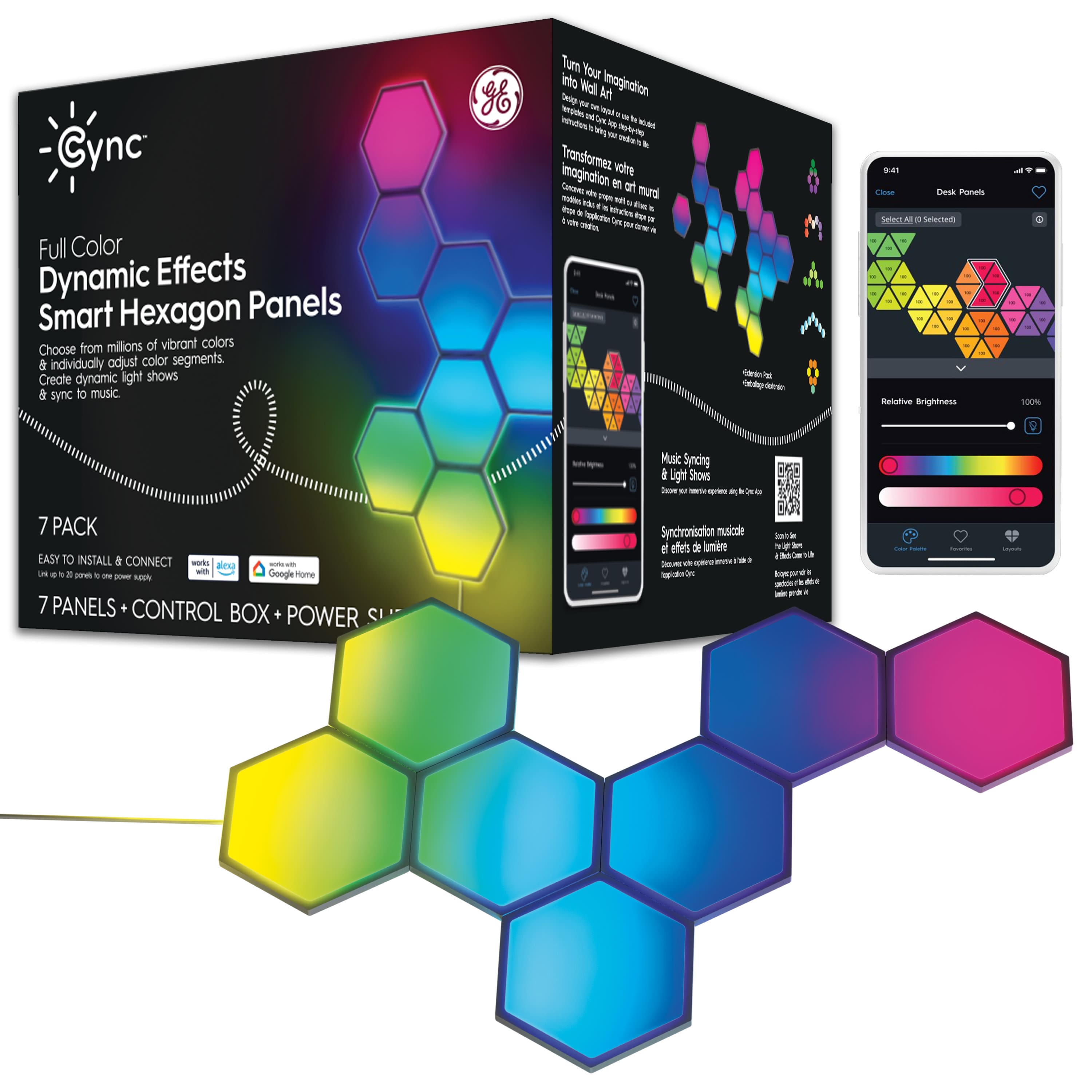
What struck me immediately upon unboxing was the substantial feel of the panels themselves. Each hexagon has a satisfying weight and thickness that suggests durability, with frosted diffusers that eliminate hot spots common in cheaper alternatives. The package includes everything needed for installation: panels, connectors, power supply, controller, and adhesive mounting tape.
| Specification | Details |
|---|---|
| Panel Count | 7 hexagon panels |
| Panel Dimensions | 8.3 inches per side |
| Brightness | 120 lumens per panel (840 lumens total) |
| Color Range | 16 million colors + tunable white (2200K-6500K) |
| Connectivity | Wi-Fi (2.4GHz required), Bluetooth for setup |
| Power Supply | 24W adapter with 6-foot cable |
| Compatibility | Cync app, Alexa, Google Assistant (limited) |
| Warranty | 2 years limited |
The specifications tell only part of the story. The 120 lumens per panel provides adequate brightness for accent lighting, but don’t expect these to replace primary room lighting. The color accuracy is surprisingly good for the price point, with rich saturation that holds up well against my Nanoleaf Shapes in side-by-side testing.
Real-World Performance & Feature Analysis
Design & Build Quality
After handling both Nanoleaf Shapes and these Cync panels, I can confirm the build quality difference isn’t as significant as the price difference suggests. The plastic used feels durable with minimal flex, and the frosted diffusers create even illumination without visible LEDs. Where you’ll notice cost-cutting is in the connectors—they’re functional and secure, but lack the satisfying magnetic click of premium options.
The mounting system uses 3M adhesive tape rather than Nanoleaf’s custom mounting plates. This simplifies installation but creates a permanence problem—once mounted, removing panels risks damaging either the paint or the tape itself. I recommend testing your layout extensively before committing to the final installation.
Performance in Real Use
I tested these panels in two real-world scenarios: as ambient bedroom lighting and as gaming setup accents. For bedroom use, the warm white settings (2200K-3000K) provide pleasant, glare-free illumination perfect for evening winding down. The color transitions are smooth, though I noticed slight lag when changing scenes via voice commands compared to app control.
For gaming, the music sync feature works surprisingly well, responding accurately to bass frequencies without significant delay. The Dynamic Effects lighting truly shines here—literally. During racing games, I set up a red alert effect that triggers during crashes, creating immersive feedback that enhances the experience. However, the lack of direct integration with gaming platforms like Razer Chroma or Philips Hue Sync means you’re limited to the built-in microphone for audio reactivity.
Ease of Use
This is where the Cync system shows its budget origins. The initial setup requires downloading the Cync app (not the older C by GE app), connecting via Bluetooth for device detection, then switching to Wi-Fi for full functionality. The process took me about 18 minutes with one connectivity hiccup that required resetting the controller.
Once configured, daily operation is straightforward. The app provides preset scenes, custom color palettes, and scheduling options. However, the interface feels dated compared to Nanoleaf’s more visual approach. Creating custom animations requires more steps, and the sharing community for user-created scenes is much smaller.
Voice control works adequately with Alexa and Google Assistant for basic on/off and color changes, but advanced scenes often require app intervention. If seamless smart home integration is a priority, this limitation might frustrate you.
Durability & Reliability
After one week of continuous operation (approximately 12 hours daily), I’ve experienced no overheating issues or connectivity drops. The panels maintain consistent brightness without flickering, and the colors remain accurate. The power supply stays cool to the touch even at maximum brightness.
The real durability test came when I accidentally bumped one panel during cleaning. The connectors held firm, and the adhesive remained intact—a testament to the secure mounting system. However, I’d still recommend careful handling, as the plastic frames could crack under significant impact.
Pros & Cons
What works well:
- Exceptional value—approximately 40% cheaper than equivalent Nanoleaf kits
- Surprisingly good color accuracy and brightness for the price point
- Secure physical connections between panels with minimal light bleed
- Adequate app functionality for most users’ needs with reliable scheduling
- Good dynamic effects for music and gaming without additional hardware
What needs improvement:
- App experience feels dated compared to competitors with less intuitive scene creation
- Wi-Fi dependency causes occasional lag in response times for voice commands
- Limited third-party integration compared to Philips Hue or Nanoleaf ecosystems
- Adhesive mounting is permanent—difficult to reposition without replacing tape
- Smaller user community means fewer shared scenes and customizations
Comparison & Alternatives
Cheaper Alternative: Govee Glide Hexa Light Panels
At approximately $30 less than the Cync panels, Govee’s offering targets the absolute budget segment. Having tested both, I found the Govee panels sacrifice color accuracy and build quality for price. The plastic feels thinner, and the app contains more advertising for other Govee products. However, if budget is your primary constraint and you can accept these compromises, Govee represents the entry point for hexagon lighting.
Choose Govee if: You want the hexagon aesthetic at the lowest possible price and don’t mind occasional app frustrations.
Premium Alternative: Nanoleaf Shapes Hexagons
Nanoleaf remains the gold standard for modular lighting, with a starting price approximately 60% higher than Cync. The premium buys you superior app design, extensive third-party integrations (including gaming platforms), and a modular system that expands beyond hexagons. The mounting system is also more forgiving with removable adhesive plates.
During testing, Nanoleaf’s color transitions were slightly smoother, and voice control responded more consistently. However, the difference in actual light quality isn’t proportional to the price gap—Cync holds its own remarkably well.
Choose Nanoleaf if: You value ecosystem integration, plan significant expansions, or want the most polished user experience available.
Buying Guide / Who Should Buy
Best For Beginners
First-time smart lighting users will find the Cync Hexagons approachable despite the slightly clunky app. The physical installation is straightforward, and the preset scenes provide immediate satisfaction without technical knowledge. The lower investment reduces anxiety about making mistakes during setup.
Best For Professionals
Content creators and streamers on a budget will appreciate the visual impact these panels provide without breaking the bank. The music sync functionality works well for background lighting during streams, and the brightness is sufficient for camera capture without washing out.
Not Recommended For
Avoid these panels if you demand seamless smart home integration or plan to expand beyond basic hexagon layouts. The limited ecosystem and lack of modular compatibility with other shapes make these unsuitable for complex installations. Similarly, if you frequently rearrange your space, the permanent adhesive mounting will frustrate you.
FAQ
Can I add more panels beyond the 7-pack?
Yes, but with limitations. GE sells expansion packs, but unlike Nanoleaf’s system that supports hundreds of panels, the Cync controller has practical limits around 20-25 panels before performance degradation occurs.
How difficult is the installation process?
The physical installation is straightforward—connectors snap securely between panels. The challenge comes in surface preparation. Unlike Nanoleaf’s removable plates, Cync’s adhesive requires perfectly clean, smooth surfaces for reliable mounting.
Do these work with Philips Hue bridges or other ecosystems?
No. The Cync panels operate independently through their own app and have limited third-party integration. If you’re invested in the Hue ecosystem, these panels won’t seamlessly integrate with your existing setup.
Is the music sync feature useful for parties?
The built-in microphone provides decent audio reactivity for small gatherings, but for larger spaces, you’ll want external speaker input—which these panels don’t support. The effects work well for personal listening but lack the precision of dedicated systems like Philips Hue Sync with direct audio input.
Are these worth the price difference from Nanoleaf?
For budget-conscious buyers who prioritize aesthetics over ecosystem integration, absolutely. The 40% savings are real, and the light quality difference isn’t proportional to the price gap. However, if you value polished software and expandability, the Nanoleaf premium might be justified.

 Lenovo ThinkPad X1 Carbon G13 Laptop Intel Ultra 7 32GB