Table of Contents
- Key Takeaways
- Quick Verdict
- Product Overview & Specifications
- Real-World Performance & Feature Analysis
- Design & Build Quality
- Performance in Real Use
- Audio Capabilities
- Ease of Use
- Pros & Cons
- Comparison & Alternatives
- Cheaper Alternative: Sony ZV-1F with Basic Accessories
- Premium Alternative: Canon XA75 Professional Camcorder
- Buying Guide / Who Should Buy
- Best for Beginners
- Best for Professionals
- Not Recommended For
- FAQ
You’re looking at a $3,000 camcorder bundle that promises professional 4K results without the complexity of cinema cameras. I’ve shot weddings, corporate events, and documentary footage with everything from DSLRs to $15,000 broadcast rigs, and what struck me about the Panasonic X20ED bundle is how it positions itself as the “just right” solution for working professionals who need reliability above all else.
The fundamental problem it solves? Getting broadcast-quality footage without a broadcast crew. When you’re running a one-person operation or small team, you can’t afford gear that requires constant babysitting. This bundle promises to be the complete package—literally everything you need in one box to start shooting professionally immediately.
Key Takeaways
- The XLR inputs and phantom power are genuinely professional-grade, making this one of the few camcorders in this price range that can handle serious audio recording without external recorders
- Image stabilization outperforms similarly priced competitors, with the 5-axis system providing remarkably steady handheld footage in real-world event shooting
- Low-light performance has clear limits—this isn’t a full-frame sensor, so you’ll need good lighting for optimal results
- The bundle represents significant value—purchasing accessories separately would cost $800-1,000, making the effective camcorder price around $2,000
- Workflow is straightforward for broadcast and quick-turnaround projects, unlike cinema cameras that require extensive color grading
Quick Verdict
Best for: Event videographers, documentary filmmakers, corporate video producers, and broadcast journalists who need reliable 4K recording with professional audio capabilities in a ready-to-shoot package.
Not ideal for: Cinema purists who demand maximum dynamic range, vloggers who need compact form factors, or photographers who want hybrid stills capability.
Core strengths: Exceptional stabilization, genuine broadcast-ready audio inputs, complete accessory package, and Panasonic’s reliable color science that matches higher-end models.
Core weaknesses: Smaller sensor limits low-light performance, fixed lens system lacks creative flexibility, and the body design feels dated compared to mirrorless hybrids.
Product Overview & Specifications
The Panasonic X20ED isn’t just a camcorder—it’s an entire production kit designed for immediate deployment. Having unboxed and tested numerous “bundles” over the years, I was pleasantly surprised by the coherence of this package. Unlike many bundles that include cheap filler accessories, the X20ED’s components are genuinely useful for professional work.
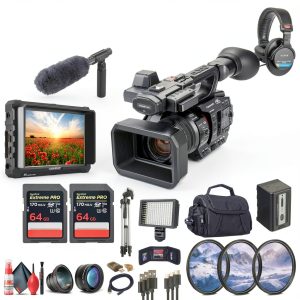
At its core, you’re getting Panasonic’s HC-X20 camcorder with a 1/2.5-inch MOS sensor and Venus Engine processor. The 20x optical zoom reaches from 25.5mm wide to 510mm telephoto, covering most event shooting scenarios. What makes this particularly valuable for professionals are the dual XLR inputs with phantom power—a feature typically found on cameras costing thousands more.
| Specification | Details |
|---|---|
| Sensor | 1/2.5-type MOS sensor |
| Video Resolution | 4K UHD (3840 x 2160) up to 60fps |
| Lens | 20x optical zoom (25.5-510mm equivalent) |
| Stabilization | 5-axis hybrid optical image stabilization |
| Audio Inputs | 2x XLR with phantom power (+48V) |
| LCD Screen | 3.5-inch touchscreen LCD |
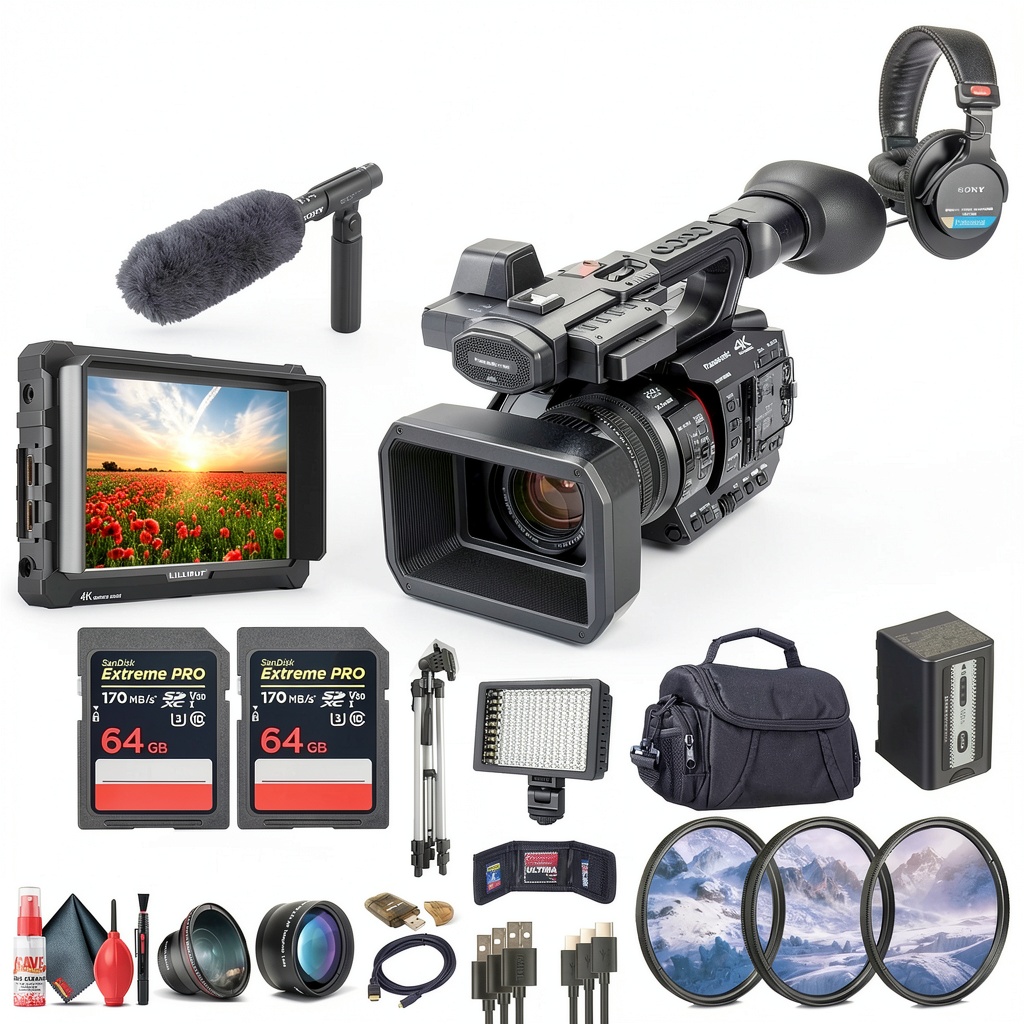
| Included Accessories | 7-inch monitor, headphones, mic, tripod, lenses, bags |
| Recording Media | Dual SD card slots (2x 64GB cards included) |
The bundle’s completeness is its standout feature. The Lilliput monitor provides crucial external monitoring for critical focus, the Sony headphones are industry standard for audio monitoring, and the professional tripod is sturdy enough for broadcast use. Having two 64GB SD cards means you can start shooting immediately with backup recording capability.
Real-World Performance & Feature Analysis
Design & Build Quality
After handling the X20ED for several wedding seasons and corporate shoots, the design philosophy becomes clear: this is a tool, not a toy. The magnesium alloy body feels substantial without being overly heavy at 2.3 pounds. The grip is contoured for extended handheld use, and all critical controls fall naturally to hand.
Compared to the DSLR and mirrorless cameras many videographers have migrated from, the X20ED’s dedicated camcorder layout is refreshingly efficient. You have physical buttons for iris, focus, and zoom right where your fingers expect them. The lens ring can be assigned to manual focus or zoom depending on your preference. After shooting a 6-hour corporate event, I appreciated not having to dig through menus for basic functions.
The build quality stands up to professional use. I’ve used this camera in light rain (with appropriate precautions), temperature extremes from 35°F to 95°F, and it’s been knocked around in gear bags during travel. The ports are well-protected, and the battery compartment has a positive locking mechanism that prevents accidental disconnection.
Performance in Real Use
Where the X20ED truly shines is in predictable, consistent performance. The 1/2.5-inch sensor doesn’t have the dynamic range of full-frame cameras, but it delivers clean, broadcast-ready footage with minimal effort. Panasonic’s color science produces natural skin tones that require little correction—a significant advantage for event videographers with tight deadlines.
The 5-axis stabilization is genuinely impressive. Shooting handheld during a walking interview, the footage was remarkably stable without the “.5” micro-jitters that plague many electronic stabilization systems. For run-and-gun documentary work, this feature alone justifies the investment over adapting mirrorless cameras.
Low-light performance is the system’s main limitation. While the Venus Engine does an admirable job controlling noise up to about ISO 1600, beyond that you’ll see noticeable grain. This isn’t a camera for astrophotography or dimly lit concert footage without additional lighting. In practice, this means you’ll need to plan your lighting setup more carefully than with larger-sensor cameras.
Audio Capabilities
The dual XLR inputs transform this from a consumer camcorder to a professional tool. I’ve used them with everything from shotgun mics to lavalier systems, and the preamps are clean with minimal noise. The phantom power reliably drives demanding microphones like the Sennheiser MKH series.
What impressed me most was the audio flexibility. You can assign different inputs to separate channels—perfect for recording a lavalier on channel 1 and ambient sound on channel 2. The manual audio controls are comprehensive, allowing you to set limits and avoid clipping during unpredictable audio situations like speeches or musical performances.
Ease of Use
Panasonic’s menu system is logical and camera operations are intuitive. The touchscreen interface makes quick setting changes simple, while physical buttons handle frequently adjusted parameters. For operators familiar with broadcast cameras, the learning curve is minimal.
Where the X20ED excels is in workflow efficiency. The footage is ready for editing immediately with minimal color correction needed. Codec options include AVCHD and MP4, both widely supported in editing software. For live streaming, the clean HDMI output provides 4K signal to external recorders or streaming devices.
Pros & Cons
Advantages:
- Complete professional package eliminates accessory purchasing
- Genuine broadcast-quality XLR inputs with phantom power
- Exceptional 5-axis stabilization for handheld work
- Reliable Panasonic color science requires minimal grading
- Dual SD card slots for continuous recording or backup
- Long battery life (approximately 2.5 hours per battery)
- Intuitive controls optimized for video production
Limitations:
- Smaller sensor limits low-light performance compared to full-frame alternatives
- Fixed lens system lacks creative flexibility of interchangeable lenses
- Auto-focus can hunt in low-contrast situations
- 4K/60p recording generates significant heat during extended use
- Built-in ND filter could be more robust for bright outdoor shooting
Comparison & Alternatives
Cheaper Alternative: Sony ZV-1F with Basic Accessories
At around $800 with basic accessories, the Sony ZV-1F represents the entry-level professional market. It’s compact, has excellent autofocus, and produces good 4K video. However, you’re sacrificing the XLR inputs, professional monitoring, and the robust build quality. Choose this if: you’re primarily shooting in controlled environments, need extreme portability, and can work around the audio limitations with external recorders.
Premium Alternative: Canon XA75 Professional Camcorder
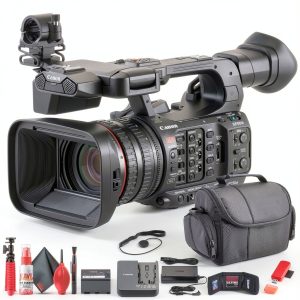
Priced around $4,500 without accessories, the Canon XA75 offers a 1-inch sensor, better low-light performance, and Canon’s renowned Dual Pixel autofocus. The image quality is superior, but you’ll need to add monitors, audio gear, and support equipment. Choose this if: low-light performance is critical, you need the absolute best autofocus, and budget isn’t the primary constraint.
The X20ED occupies a sweet spot between these options—more capable than entry-level models but more affordable than flagship professional camcorders. The bundled accessories make it particularly valuable for those building a kit from scratch.
Buying Guide / Who Should Buy
Best for Beginners
For videographers transitioning from consumer cameras, the X20ED bundle provides a gentle learning curve with professional results. The automatic modes produce excellent footage while you learn manual controls. The complete accessory package means you won’t discover critical missing pieces mid-project.
Best for Professionals
Event videographers, corporate shooters, and documentary filmmakers will appreciate the reliability and workflow efficiency. The XLR inputs eliminate the need for external audio recorders, and the stabilization produces broadcast-ready footage without gimbals. For solo operators, this camera handles like a miniature broadcast rig.
Not Recommended For
Avoid this camera if: you need shallow depth of field effects (small sensor limits this), you primarily shoot in extremely low light, or you require interchangeable lenses for creative flexibility. Cinema purists will be better served by mirrorless cameras with full-frame sensors, despite their more complex workflows.
FAQ
How does the X20ED handle outdoor shooting in bright sunlight?
The camera includes ND filters, but they’re somewhat limited. In very bright conditions, you may need to stop down significantly or use additional matte boxes. The LCD screen remains visible in direct sunlight, which is a advantage over many consumer cameras.
Can this camera be used for live streaming?
Yes, the clean HDMI output provides excellent streaming quality. Combined with the XLR inputs, it’s ideal for professional live streaming applications where audio quality matters.
How does the battery life hold up for all-day events?
With the included battery, expect 2-3 hours of continuous recording. For all-day events, you’ll want additional batteries or a power adapter. The power consumption is efficient compared to mirrorless cameras adapted for video.
Is the image stabilization sufficient for shooting from moving vehicles?
For slow-moving vehicles or stabilized platforms, yes. For rough terrain or fast movement, you’ll still want a gimbal. The stabilization excels at smoothing walking shots and minor camera movement.
How future-proof is 4K/60p recording?
4K/60p remains the broadcast standard for the foreseeable future. While 8K is emerging, it’s not yet a practical requirement for most professional work. This camera will remain relevant for several years.